
Build reading and number confidence
Develop regular reading, vocabulary, spelling, mental arithmetic and problem-solving habits. Use short assessments to understand strengths and gaps without intensive exam drilling.
Build strong foundations in English, mathematics and reasoning through a clear Year 3–6 learning pathway.
A structured preparation pathway for UK independent school and grammar school entry: begin in Year 3, establish essential skills in Year 4, strengthen performance in Year 5 and refine exam readiness in Year 6. Year 4 is the key foundation stage, not a year for excessive timed papers.
Develop regular reading, vocabulary, spelling, mental arithmetic and problem-solving habits. Use short assessments to understand strengths and gaps without intensive exam drilling.
Move to structured comprehension, inference, vocabulary, grammar, writing organisation, arithmetic fluency and multi-step reasoning. Begin suitable verbal and non-verbal reasoning familiarisation where relevant to target schools.
Deepen comprehension, creative writing and higher-level problem solving; practise question formats and progressively introduce timed work. Refine school selection and prepare for applicable registration deadlines.
Focus on identified weaknesses, mock exams, time management, interview skills and school-specific requirements. For many 11+ routes, key entrance tests occur in the autumn of Year 6.
These are curriculum-aligned development goals, not a claim that the National Curriculum sets the content of every independent-school entrance test.
The current Year 4 posters describe 11+ preparation and related reading development. A suitable study plan combines English comprehension and writing, mathematics and reasoning, regular independent reading, homework feedback and periodic progress review. Individual class times, teaching venues and fees should be confirmed against the current poster and with our team.
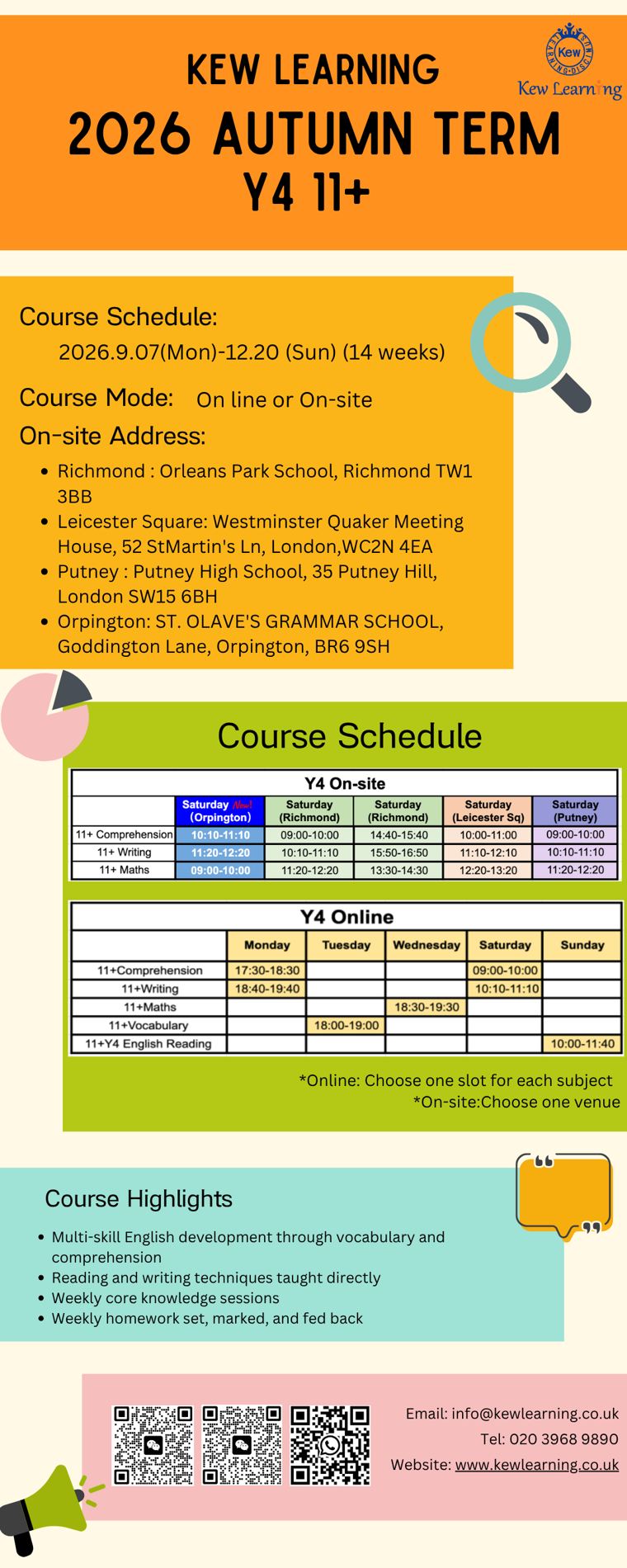
See the Year 4 11+ preparation advert and the Year 4–5 reading programme, with original poster details.
| School period | Published Kew Learning dates | Suggested Year 4 focus |
|---|---|---|
| Autumn Term 2026 | 7 Sep – 20 Dec 2026 | Baseline review, reading routine, English and maths foundations |
| October Half Term Camp | 26–30 Oct 2026 | Optional consolidation and focused practice |
| Autumn Mock Exam | 29 Nov 2026 | Check suitability with the teaching team; not every Y4 learner needs an exam mock |
| Spring Term 2027 | 4 Jan – 28 Mar 2027 | Deeper comprehension, writing structure and problem solving |
| February Half Term Camp | 15–19 Feb 2027 | Optional reinforcement |
| Spring Mock Exam | 7 Mar 2027 | Optional progress check if age-appropriate |
| Summer Term 2027 | 12 Apr – 25 Jul 2027 | Review progress and plan the Year 5 transition |
| June Half Term Camp / Summer Mock | 1–4 Jun / 27 Jun 2027 | Optional enrichment and assessment |
Dates above are transcribed from Kew Learning's published 2026–2027 calendar. The learning focus is guidance, not a confirmed class timetable.
Begin with a diagnostic discussion and work samples, agree achievable reading and maths targets, review classwork and homework during the term, and adjust the plan for Year 5. Specific target schools may require English, mathematics, reasoning, writing samples or interviews; Kew Learning can help families map these requirements separately.