
Year 6 11+ Final Preparation
Focused English, mathematics and reasoning practice for school entrance assessments.
Follow a staged Year 3 start → Year 4 foundation → Year 5 intensive development → Year 6 optimisation pathway, tailored to 11+ and 13+ admissions.
Year 3–6 Preparation Pathway
English, maths and reasoning
Depth and question formats
Mocks, feedback and interviews
Year 6 focus: Build a school-specific revision plan from diagnostic results: address gaps, time management, reading speed, writing structure and interviews. Many 11+ tests occur early in Year 6 autumn; check registration deadlines in advance.
English, Mathematics and Reasoning Objectives
Curriculum basis: English and mathematics objectives are aligned broadly with the England National Curriculum for Upper Key Stage 2 (Years 5–6). Verbal and non-verbal reasoning are entrance-test extensions, not separate statutory National Curriculum subjects. Individual 11+, 13+ pre-test and Common Entrance requirements differ by school.
English · Reading and Writing
- Read demanding fiction, non-fiction and poetry; retrieve evidence, infer meaning, compare viewpoints and summarise accurately.
- Explain authorial vocabulary and language choices; develop breadth of vocabulary and spelling.
- Plan narratives and non-fiction writing with paragraphs, cohesion, varied sentence structures and accurate grammar/punctuation.
- Draft, revise and proofread; practise well-structured answers under gradually increasing time limits.
Mathematics · Fluency and Problem Solving
- Apply place value and all four operations with whole numbers; practise multi-step word problems and estimation.
- Work with fractions, decimals and percentages; compare and convert quantities where appropriate.
- Use measures, geometry, properties of shapes, coordinates and data interpretation.
- Show reasoning, choose efficient strategies, check answers and build accuracy before speed.
Reasoning · Verbal and Non-Verbal
- Verbal reasoning: vocabulary relationships, analogies, codes, sequences and careful interpretation of instructions.
- Non-verbal reasoning: patterns, symmetry, rotations, matrices and spatial relationships.
- Mathematical reasoning: multi-stage problems, missing information, logic and justification.
- Reasoning formats are school-specific entrance preparation, not a separately prescribed National Curriculum subject.
Kew Learning Programme
This page outlines the overall Year 5/6 preparation pathway. Confirm subject class times, venues and fees from current posters and the admissions team.
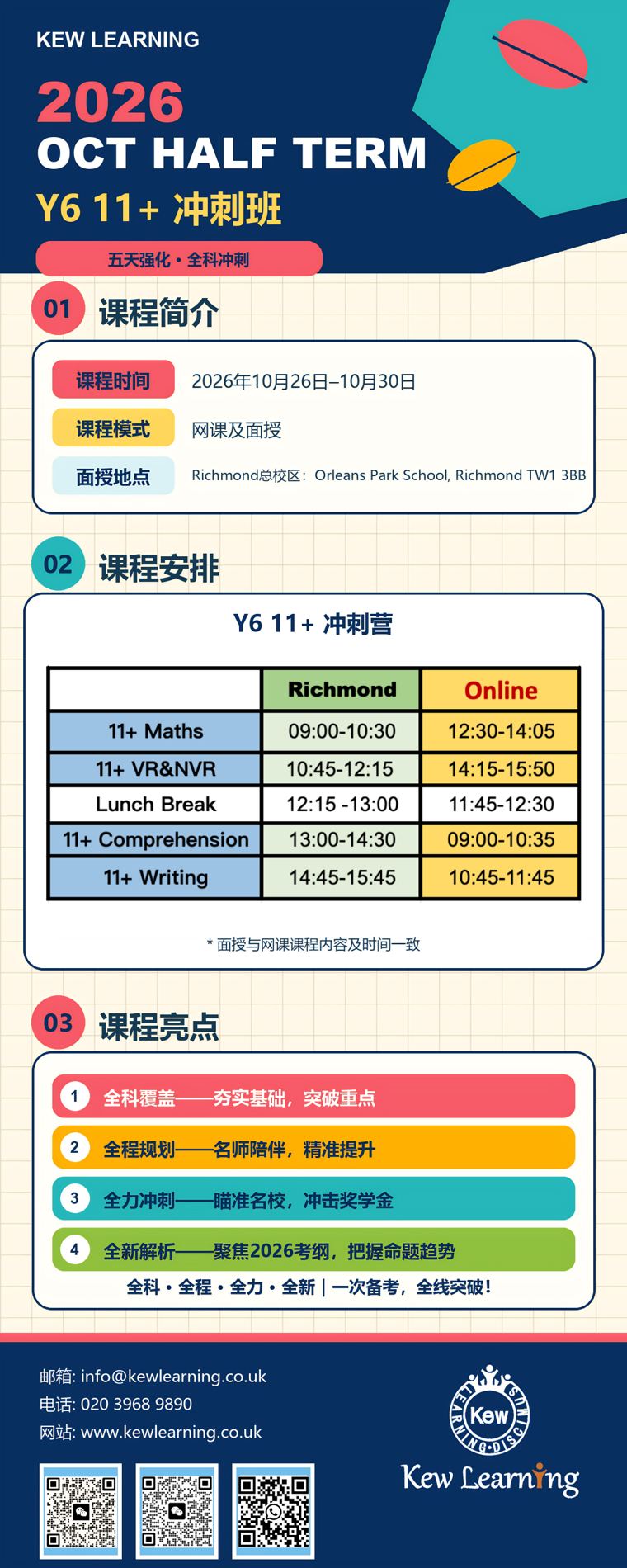
View Year 6 posters
Explore the current year-group poster, holiday camps and related course information.
2026–2027 Academic Calendar and Preparation Rhythm
| School period | Published calendar dates | Suggested preparation focus |
|---|---|---|
| Autumn Term 2026 | 7 Sep – 20 Dec 2026 | 11+ autumn tests and targeted revision |
| October Half Term Camp | 26–30 Oct 2026 | Only if relevant to target schools |
| Autumn Mock Exam | 29 Nov 2026 | Only if appropriate |
| Spring Term 2027 | 4 Jan – 28 Mar 2027 | 13+ progression and interviews |
| February Half Term Camp | 15–19 Feb 2027 | Address remaining gaps |
| Spring Mock Exam | 7 Mar 2027 | Depends on admissions route |
| Summer Term 2027 | 12 Apr – 25 Jul 2027 | Prepare for next school stage |
| June Half Term Camp / Summer Mock | 1–4 Jun / 27 Jun 2027 | Optional enrichment |
Dates follow Kew Learning’s existing 2026–2027 calendar; suggested focus is guidance, not a confirmed class timetable.
Progress Reviews and 11+ / 13+ Admissions
Review reading, writing, mathematics and reasoning against target-school requirements, with regular feedback and appropriate mock tests. 11+ generally concerns Year 7 entry; 13+ generally concerns Year 9 entry and may involve earlier pre-tests and later school-specific assessments. Always check official admissions guidance.